

Why Your Google Ads Aren’t Generating Leads (And How to Fix Them)
The Complete Google Ads Optimization Guide for Better ROI in 2026
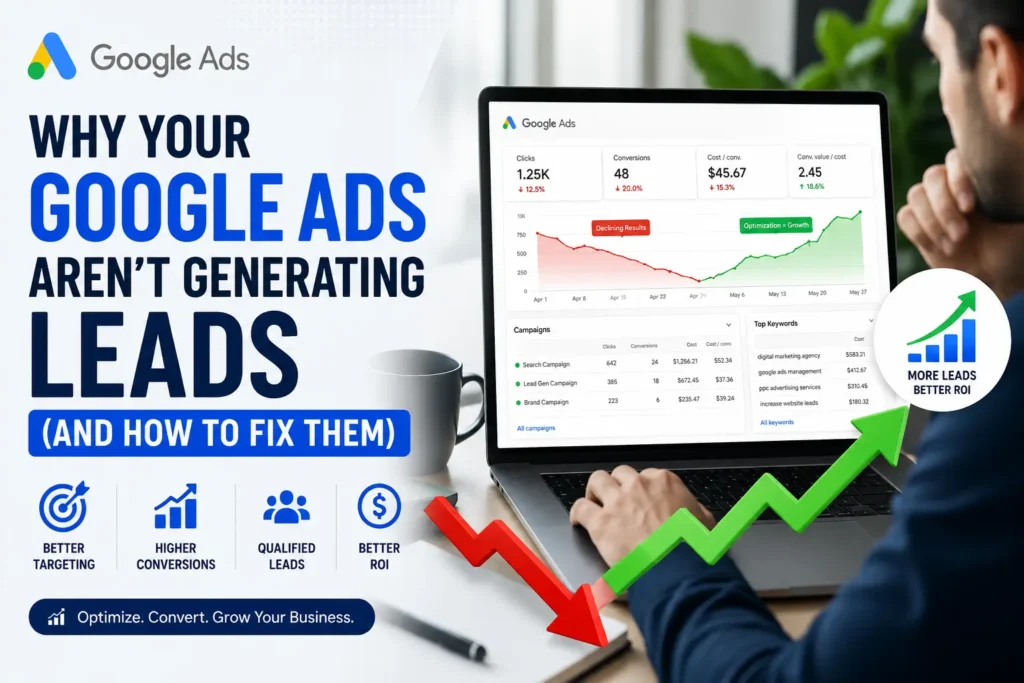
Google Ads remains one of the most powerful digital marketing platforms available today. Businesses can reach customers exactly when they’re searching for products or services, generate qualified leads, and drive measurable revenue.
Yet there’s a frustrating reality many business owners face:
They’re spending money on Google Ads every month but seeing very few leads, poor conversions, and disappointing ROI.
If that sounds familiar, you’re not alone.
The good news is that most Google Ads failures aren’t caused by the platform itself. Instead, they’re usually the result of a few common mistakes that can be identified and fixed.
In this guide, we’ll explore the biggest reasons why Google Ads campaigns fail and the practical steps you can take to improve your performance, reduce wasted ad spend, and generate more qualified leads.
Why Google Ads Performance Matters
Before diving into the mistakes, it’s important to understand what makes a successful Google Ads campaign.
A high-performing campaign should:
- Generate qualified leads
- Maintain a healthy Cost Per Lead (CPL)
- Achieve a strong Return on Ad Spend (ROAS)
- Deliver measurable business growth
- Convert website visitors into customers
If you’re not seeing these results, one or more areas of your campaign likely need optimization.
1. You’re Targeting the Wrong Keywords
Keyword targeting is the foundation of every Google Ads campaign.
Many advertisers make the mistake of targeting broad keywords because they believe more traffic means more leads.
Unfortunately, that’s not how it works.
Example:
Imagine you own a digital marketing agency.
Targeting a keyword like:
“marketing”
is extremely broad.
However, targeting:
“digital marketing agency in Bangalore”
or
“Google Ads consultant near me”
is much more specific and attracts users with buying intent.
How to Fix It
- Focus on high-intent keywords
- Use Phrase Match and Exact Match keywords
- Research search intent before selecting keywords
- Review Search Terms Reports regularly
- Add relevant long-tail keywords
Primary Keywords
- Google Ads Optimization
- Keywords
- PPC Advertising
- Google Ads Campaign Management
2. You’re Ignoring Negative Keywords in Google Ads
One of the biggest causes of wasted ad spend is failing to use negative keywords.
Without negative keywords, Google may show your ads for irrelevant searches.
Example
If you’re selling premium digital marketing services, you probably don’t want traffic from searches like:
- Free marketing services
- Digital marketing internship
- Marketing jobs
These clicks cost money but rarely convert.
How to Fix Google Ads errors
Create a negative keyword list containing:
- Free
- Jobs
- Internship
- Training
- Tutorial
- Course
Review your Search Terms Report every week and continuously add new negative keywords.
This simple habit can dramatically improve Google Ads ROI.
3. Your Ad Copy Isn’t Convincing
Even if you’re targeting the right keywords, poor ad copy can destroy your click-through rate.
Your ads must instantly answer one question:
“Why should someone choose you instead of your competitors?”
Weak Ad Example
Best Digital Marketing Agency
Better Ad Example
Generate More Leads with Google Ads
Certified Experts | Free Consultation | Proven Results
Notice the difference?
The second ad clearly communicates value and encourages action.
How to Fix It
Include:
- Benefits
- Unique Selling Points (USP)
- Strong Call-to-Action (CTA)
- Social proof
- Numbers and results when possible
Examples of effective CTAs:
- Get Free Audit
- Book a Strategy Call
- Get a Free Quote
- Start Today
4. Your Landing Page Is Killing Conversions
Many businesses focus entirely on ads and forget about the landing page experience.
Even the best campaign will fail if visitors land on a confusing or slow website.
Common Landing Page Mistakes in Google Ads
- Slow loading speed
- Poor mobile experience
- Weak headlines
- Too many distractions
- No clear CTA
How to Fix It
A high-converting landing page should include:
- Clear headline
- Strong value proposition
- Customer testimonials
- Benefits-focused content
- Lead capture form
- Fast page speed
Pro Tip
Aim for a page load speed under 3 seconds.
Every additional second can reduce conversion rates significantly.
5. You’re Not Tracking Conversions Properly
If conversion tracking isn’t configured correctly, you’re essentially driving blind.
Many businesses optimize campaigns based on clicks instead of actual business results.
Important Conversions to Track
- Lead form submissions
- Phone calls
- WhatsApp inquiries
- Purchases
- Demo requests
- Newsletter signups
How to Fix It
Set up:
- Conversion Tracking
- Google Analytics 4 (GA4)
- Google Tag Manager
- Enhanced Conversions
Tracking allows you to understand exactly which campaigns, keywords, and ads generate revenue.
6. You’re Using the Wrong Bidding Strategy
Google’s bidding options have evolved significantly over the years.
Many advertisers still rely on manual bidding when automated bidding may produce better results.
Popular Smart Bidding Strategies
- Maximize Conversions
- Maximize Conversion Value
- Target CPA
- Target ROAS
How to Fix It
Choose a bidding strategy based on your objective:
If your goal is lead generation:
Use Maximize Conversions.
If your goal is revenue growth:
Use Target ROAS.
Always give Google’s algorithm sufficient conversion data before making major adjustments.
7. You’re Not Optimizing Campaigns Regularly
Google Ads is not a “set it and forget it” platform.
Markets change.
Competitors change.
Search behavior changes.
Campaigns require ongoing optimization.
Weekly Optimization Checklist
✓ Review keyword performance
✓ Add negative keywords
✓ Analyze search terms
✓ Monitor conversion rates
✓ Adjust bids
✓ Test new ad copy
✓ Improve landing pages
✓ Review audience targeting
Consistent optimization often separates profitable campaigns from unprofitable ones.
Bonus Tip: Focus on Leads, Not Clicks
One of the most common mistakes businesses make is celebrating clicks.
Clicks don’t pay the bills.
Leads and customers do.
Instead of asking:
“How many clicks did we get?”
Ask:
“How many qualified leads did we generate?”
That’s the metric that truly matters.
Final Thoughts
Google Ads can be one of the most profitable marketing channels for your business when managed correctly.
If your campaigns aren’t generating leads, don’t immediately assume Google Ads doesn’t work.
More often than not, the problem lies in targeting, tracking, ad copy, landing pages, or campaign optimization.
By fixing these common issues, you can reduce wasted ad spend, improve conversion rates, and generate significantly better results from your advertising budget.
Remember: Successful Google Ads campaigns aren’t built overnight. They require continuous testing, optimization, and refinement.
Start implementing these strategies today, and you’ll be well on your way to turning your Google Ads campaigns into a predictable lead-generation machine.